
https://amee.org/conferences/amee-2020/programme/best-practice/sustaining-the-move-to-online-teaching-and-learnin
Best Practice session at AMEE 2020: The Virtual Conference – 7-9 September 2020
Sustaining the move to online teaching and learning during and after the COVID-19 pandemic
Abstract:
The COVID-19 pandemic has seen a huge global shift to online delivery of the curriculum, with many innovative approaches. Sustaining these changes to provide high quality teaching and learning using online approaches will require a transformational change in learners, educators and institutions. This change will be a challenge for all medical educators, in both high and low resource settings. An essential aspect of responding to this challenge will be a transformational change in the scholarship of medical education to ensure that rapid cycles of evaluation can inform best practice.
Chair - John
Presenters
Transformational change in learners (12 minutes) - Monika
Transformational change in educators and institutions (12 minutes) - Kalyani
Transformational change in the scholarship of medical education (12 minutes) - John and Poh-Sun
- Key areas to change and effective responses based on 'best practice' and examples eg from MedEdPublish
- Importance of rapid iterative cycles of evaluation to refine interventions through use of action research and educational design research, and rapid dissemination.
-Consider implications for providing evidence.
-Recommendations on 'best practice' and examples eg from MedEdPublish
- Session Padlet wall link
https://padlet.com/dnrgohps/SustainingOnlineTeachingLearningScholarshipAMEE20
(this open access online discussion space can be used by participants to post questions, and comment on points brought up during the session - to document this, and make this visible before, during and after the conference session)
(this open access online discussion space can be used by participants to post questions, and comment on points brought up during the session - to document this, and make this visible before, during and after the conference session)


🔻
⬇
⏯ Segment presentation Slide Deck below

or click / tap on image above
⏯ Screencastify link for my presentation (Video and Audio)


 above avatar for Poh-Sun Goh
@ AMEE 2020
or click / tap on image above
⏯ Screencastify link for my presentation (Video and Audio)


Delegates can submit questions through Slido during the session. You can use the direct link below to access those questions. After clicking the Slido link please choose your session code from the drop down menu in the top right corner. The page will then show you the questions as they are being asked.
BP9.1 Slido Q&A Link:
BP9.2 Slido Q&A Link:

@ AMEE 2020


Recording of live Q and A available on demand (online), with
elaboration on answers to some of the posted questions on session Padlet, also screenshot below.

https://public.virtwayevents.com/launch/AMEE-2020
post Virtual AMEE 2020 access videos on demand (of presentations and live Q and A) at
AMEE Resource Centre (via My Account link, after signing in)
Slide Deck for my presentation below
post Virtual AMEE 2020 access videos on demand (of presentations and live Q and A) at
AMEE Resource Centre (via My Account link, after signing in)
Slide Deck for my presentation below
Sustaining the move to online teaching and learning during and after the Covid-19 pandemic - Transformational change in the scholarship of medical education (Slide Deck) from Poh-Sun Goh

Supplementary slide below
Technology transforming medical education and scholarship from Poh-Sun Goh
https://www.slideshare.net/dnrgohps/digital-scholarship-in-medical-education-145349537
https://www.slideshare.net/dnrgohps/digital-scholar-the-scholarship-cycle-valueimpactrecognition
https://www.slideshare.net/dnrgohps/building-blocks-of-digital-scholarship-in-medical-education
Building a portfolio of academic scholarship and The academic cycle
by
Goh Poh Sun (first draft on April 10th, 2016 at 1737hrs)
"The process of building a portfolio of academic scholarship requires attention to, as well as regular participation in and focus on an area of academic work; getting training, building experience, and developing an understanding of current and topical academic conversations in that area; by reading, attending major academic conferences, through conference presentations, presenting at symposia and workshops; developing ideas further and deepening insights through reflection and discourse; then continuing the academic cycle by getting feedback on these insights by progressively disseminating these ideas through case studies, reflection pieces and peer reviewed papers, both online and through traditional academic peer reviewed publications and conference presentations."

https://www.slideshare.net/dnrgohps/digital-scholarship-in-medical-education-145349537
https://www.slideshare.net/dnrgohps/digital-scholar-the-scholarship-cycle-valueimpactrecognition
https://www.slideshare.net/dnrgohps/building-blocks-of-digital-scholarship-in-medical-education

🔻
⬇
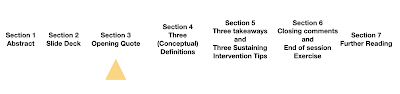
⏯ Opening quote below
Building a portfolio of academic scholarship and The academic cycle
by
Goh Poh Sun (first draft on April 10th, 2016 at 1737hrs)
"The process of building a portfolio of academic scholarship requires attention to, as well as regular participation in and focus on an area of academic work; getting training, building experience, and developing an understanding of current and topical academic conversations in that area; by reading, attending major academic conferences, through conference presentations, presenting at symposia and workshops; developing ideas further and deepening insights through reflection and discourse; then continuing the academic cycle by getting feedback on these insights by progressively disseminating these ideas through case studies, reflection pieces and peer reviewed papers, both online and through traditional academic peer reviewed publications and conference presentations."

➡ Sustainable/sustaining implementation tip: For faculty, get training. For institutions, provide training (faculty development).
example of faculty development workshop below, and best practice session

🔻
⬇
⏯ Three (conceptual) definitions:
➡ 'Best Practice is' - 'A technique or methodology that, through experience and research, has proven to reliably lead to a desired result'.
quoted from
https://searchsoftwarequality.techtarget.com/definition/best-practice#
➡ 'Digitalisation is' - 'Digitalisation is the incorporation of digital technologies into business/social processes, with the goal of improving them'.
quoted from
https://www.scrive.com/digitalisation/
➡ 'Digital transformation is' - 'a change in how a firm employs digital technologies, to develop a new digital business model that helps to create and appropriate more value for the firm'.
quoted from
Peter C. Verhoef, Thijs Broekhuizen, Yakov Bart, Abhi Bhattacharya, John Qi Dong, Nicolai Fabian, Michael Haenlein. (2019) 'Digital transformation: A multidisciplinary reflection and research agenda',
Journal of Business Research,
ISSN 0148-2963, https://doi.org/10.1016/j.jbusres.2019.09.022.
(http://www.sciencedirect.com/science/article/pii/S0148296319305478)
and
- 'Digital transformation marks a radical rethinking of how an organization uses technology, people and processes to fundamentally change business performance'.
George Westerman
MIT principal research scientist
Author of Leading Digital: Turning Technology Into Business Transformation
quoted in
https://www.cio.com/article/3211428/what-is-digital-transformation-a-necessary-disruption.html
and
- 'Digital transformation is a foundational change in how an organization delivers value to its customers'.
Clint Boulton
quoted from
https://www.cio.com/article/3211428/what-is-digital-transformation-a-necessary-disruption.html
https://www2.deloitte.com/il/en/pages/innovation/article/disruptive_vs_sustaining.html
https://hbr.org/2015/12/what-is-disruptive-innovation
https://claytonchristensen.com/key-concepts/
https://sites.google.com/site/saundersij/innovation-theory/sustaining-innovation
http://strategictoolkits.com/strategic-concepts/disruptive-and-sustaining-innovation/

🔻
⬇
⏯ Three takeaways and three sustaining implementation tips:
Three takeaways:
Poh-Sun Goh
⏯First takeaway: Digital Content (for Teaching and Scholarship)
1. Digital content (created and curated), the web, software (apps) and mobile devices enable educators to connect with learners with much less resource constraints than earlier generations, much faster, and easier. Digital content includes digital artefacts and evidence of our scholarly efforts. Our scholarly output is visible, accessible, and assessable - both quantity and quality.
Goh, P.S. eLearning or Technology enhanced learning in medical education - Hope, not Hype. Med Teach. 2016 Sep; 38(9): 957-958, Epub 2016 Mar 16
http://www.ncbi.nlm.nih.gov/pubmed/26982639
Expanded narrative for first takeaway below.
Technology enhanced learning, or eLearning.
Reflecting on my use of Technology in teaching, learning, and in faculty development today.
Key words which come to mind include ‘ease” of use, ‘expanding’ and ‘extending’ access, and my reach as a teacher, with students and trainees, and fellow teachers. To create, and curate content (with attribution), including graphics, video and multimedia. To work together, and collaborate.
There is great democratisation of access to, and understanding of how to use the tools and platforms available. We start off with digital content (our PowerPoint deck comes to mind), which can then be accessed, and shared, in multiple formats and forms.
➡ Sustainable/sustaining implementation tip: Focus on curating and creating reusable, granular and modular digital content accessible and assessable on online digital repositories - (some open access, some restricted access digital content following appropriate and accepted professional usage guidelines, including those for professional use, consent, privacy, and attribution/intellectual property). This includes digital artefacts and examples of our scholarly output, in digital portfolios.
The limiting factors are time, motivation, awareness, training - including in pedagogy, instructional design and design thinking, and an experimental, rapid improvement, scholarly and scholarship mindset, and mindfulness of not only the positive use of technology, but also the ‘dark’ side of technology use, and pitfalls in its use.
All this against a backdrop of ongoing rapid, exciting, exponential expansion of technology adoption and use by increasing numbers of individuals worldwide, with technology development, and innovative application of technology within, and outside education making the news on a daily basis. The excitement, and engagement I feel with technology use is due to many of the features and points made in Step 1 (section first posted on blogpost below).
https://medicaleducationelearning.blogspot.com/2018/12/what-is-technology-enhanced-learning.html
⏯Second takeaway: Digital platforms (for Teaching and Scholarship)
2. Technology/Digitalisation enables rapid content curation, and much easier content creation, and dissemination, aided by low cost and open access platforms and tools which promote access, and visibility of our educational and training efforts. This includes digitalisation of the scholarly process. Indicators and metrics, visibility and access to intermediate and final outcomes of our scholarly activities to engage with, evaluate and assess.
Goh, P.S. Using a blog as an integrated eLearning tool and platform. Med Teach. 2016 Jun;38(6):628-9. Epub 2015 Nov 11. http://www.ncbi.nlm.nih.gov/pubmed/26558420
Expanded narrative for takeaway 2 below.
Digital Scholarship and Engagement - Indicators, Metrics, Value and Impact
eLearning or TEL(Technology Enhanced Learning) is increasingly being integrated into medical education and training, from undergraduate, through postgraduate to continuing education and lifelong learning settings, with increasing emphasis on blended and mobile learning, in the workplace and just-in-time settings. TEL with utilisation of digital content and engagement provides visibility of our teaching and training efforts as educators, showing ‘what we teach with, and assess on’ (Goh, 2016). TEL approaches can also be used to provide visibility and metrics of student engagement, as well as demonstrate intermediate and final outcomes of student learning (Goh & Sandars, 2016; Goh, 2017). TEL is increasing transforming medical education, going beyond substitution, augmentation and modification of learning - the ‘SAMR model’ (Puentedura, 2013). Reflective educators, and educational scholars have always sought to evaluate and assess the value and impact of their teaching and training efforts, and Digital Scholarship, with attention paid to data, indicators and metrics of engagement and output, can facilitate these efforts. Use of 'free', low cost, off the shelf, easy to use and accessible digital tools and platforms, combined with curated and created digital content repositories, by faculty who are 'digitally literate' and professional, facilitates adoption and scaling up of our scholarly efforts (Goh, 2018). This has direct benefits for faculty members during the academic appointment, appraisal and promotion process; for an academic community by making scholarly activities easily accessible, and for an institution by making academic and scholarly activities by faculty members both easily accessible and visible.
(above posted earlier on blogpost link below)
https://medicaleducationelearning.blogspot.com/2018/09/digital-scholarship.html
➡ Sustainable/sustaining implementation tip: Use open access and usable/easy to use low cost technology tools and platforms. Know what tech is available to faculty and students. Which can be used to support our teaching, and scholarly efforts.
https://www.slideshare.net/dnrgohps/adoption-of-elearning-in-med-ed-costs-and-value-add-82738401
⏯Third takeaway: Digital processes (for Teaching and Scholarship)
3. Rapid cycle, by design, iterative, cumulative educational and scholarly efforts assisted and augmented by technology promotes academic discourse and peer critique and feedback, building and adding to communities of practice as educators, and scholars. Technology enhances and offers the potential to transform educational scholarship.
Goh P.S, Sandars J. (2020) 'Rethinking scholarship in medical education during the era of the COVID-19 pandemic', MedEdPublish, 9, [1], 97, https://doi.org/10.15694/mep.2020.000097.1
https://www.mededpublish.org/manuscripts/3116
https://www.slideshare.net/dnrgohps/digital-scholarship-in-medical-education-145349537
Expanded narrative for takeaway 3 below.
Our creativity, and innovation efforts are assisted by technology to enable rapid cycle action research, informed by design thinking principles. Creativity, Curation, Transfer to Practice, and Digital Teaching (with learning analytics making the educational and training process as well as intermediate and final outcomes of learning and training visible, accessible and available for evaluation) have analogies with accepted categories of the Scholarship of Discovery, Integration, Application and Teaching. By being open, accessible and assessable, technology facilitates, enables, and augments both traditional and newer forms of scholarship, and provides visibility and evidence of this for academic review and recognition. The COVID-19 pandemic has illustrated the impact of open sharing of clinical and educational case studies, and clinical practices (both effective, and less so) in a collaborative, networked world - for example https://www.nejm.org/coronavirus (NEJM Covid-19 resources) and https://amee.org/covid-19 (AMEE Covid-19 resources, including interactive webinars, and rapid open access post publication peer review online journal articles in MedEdPublish). This facilitates peer and academic critique, commentary and possibilities to learn from, and add to the efforts of individuals, groups and societies, with impact illustrated vividly and openly in our public health response to the Covid-19 pandemic; and rapid, usable, useful and effective widespread implementation of online learning and training.
➡ Sustainable/sustaining implementation tip: What before Why and How. Know purpose/outcomes, pedagogy, content and technology. Practices founded on empirical observation, experience, feedback, data, evidence, evaluation (of outcomes and impact) and scholarship. Digital artefacts and examples of our scholarly output within digital portfolios can be systematically, progressively and cumulatively assembled, following accepted traditional and newer criteria (quantitative and qualitative) for assessing and evaluating academic output, and impact, producing a coherent narrative and portfolio of academic work. Digitalisation and technology facilitates and potentially transforms the process, outputs and outcomes of our academic work.
https://www.slideshare.net/dnrgohps/building-blocks-of-digital-scholarship-in-medical-education
'Online viewership of an educational scholars digital output is a proxy for quantitative impact; and the type and extent of dissemination and discussion a proxy for qualitative impact; with similarities to traditional scholarship. To illustrate this ... '
and
'Digital platforms have the added advantage of augmenting and accelerating the dissemination and potential critique of educational ideas, by promoting access and leveraging on the strength, connectivity and reach of the internet. From this perspective, the volume of digital viewership and downloads is evidence of the value, and usefulness of online content. The type, nature, extent and depth of online (similar to traditional) dissemination and discussion of digital content is evidence of the value and worth of the digital content.'
above quotes from Digital Scholarship section, article below
Goh PS, 2016, 'The value and impact of eLearning or Technology enhanced learning from one perspective of a Digital Scholar', MedEdPublish, 5, [3], 31, https://doi.org/10.15694/mep.2016.000117
https://www.mededpublish.org/manuscripts/613
for example
⏯Goh P.S, Sandars J. (2020) 'A vision of the use of technology in medical education after the COVID-19 pandemic', MedEdPublish, 9, [1], 49, https://doi.org/10.15694/mep.2020.000049.1
https://www.mededpublish.org/manuscripts/2943
(2020) Top-rated MedEdPublish Articles – March 2020, Medical Teacher, 42:7, 832, DOI: 10.1080/0142159X.2020.1762062
(over 11,000 views, and 9 reviews, and 30 citations on Google Scholar as of 6 September 2020)
⏯Sandars, J., Correia, R., Dankbaar, M., de Jong, P., Goh, P.S., Hege, I., Masters, K., Oh, S.Y., Patel, R., Premkumar, K., Webb, A., Pusic, M. (2020). 'Twelve tips for rapidly migrating to online learning during the COVID-19 pandemic'. MedEdPublish, 9, [1], 82, https://doi.org/10.15694/mep.2020.000082.1
https://www.mededpublish.org/manuscripts/3068
(2020) Top-rated MedEdPublish Articles – April 2020, Medical Teacher, 42:8, 952, DOI: 10.1080/0142159X.2020.1774483
(over 11,000 views, and 7 reviews, and 13 citations on Google Scholar as of 6 September 2020)
⏯Liaw SY, Augustin CG, Ying L, Tan SC, Lim WS, Goh PS. Multiuser Virtual Worlds in Healthcare Education: A Systematic Review. Nurse Education Today. Volume 65, June 2018, Pages 136-149. https://doi.org/10.1016/j.nedt.2018.01.006 Accepted for publication on 11 January 2018, available online 2 February 2018).
(22 citations on Google Scholar, 13 citations on Scopus, PlumX Metrics of paper as of 18 July 2020, more about https://plumanalytics.com/learn/about-metrics/)
⏯Goh, P.S. The value and impact of eLearning or Technology enhanced learning from one perspective of a Digital Scholar. MedEdPublish. 2016 Oct; 5(3), Paper No:31. Epub 2016 Oct 18.
http://dx.doi.org/10.15694/mep.2016.000117
(over 3250 views, and 3 reviews, and 4 citations on Google Scholar as of 18 July 2020)
⏯Goh, P.S. eLearning or Technology enhanced learning in medical education - Hope, not Hype. Med Teach. 2016 Sep; 38(9): 957-958, Epub 2016 Mar 16
http://www.ncbi.nlm.nih.gov/pubmed/26982639
(over 1,100 views, 18 citations on Google Scholar, 12 CrossRef citations, Altmetric score 7 as of 18 July 2020)
⏯Dong C, Goh PS. Twelve tips for the effective use of videos in medical education. Med Teach. 2015 Feb; 37(2):140-5.
http://www.ncbi.nlm.nih.gov/pubmed/25110154
(over 3,500 views, 84 citations on Google Scholar, 45 CrossRef citations, Altmetric score 25 as of 6 September 2020)
https://www.slideshare.net/dnrgohps/everything-i-have-learnt-about-elearning
(over 34,000 views on SlideShare as of 12 July 2020)
https://www.slideshare.net/dnrgohps/reflect-on-how-blooms-taxonomy-and-millers-pyramid-might-apply-to-learning-continuum-map
(over 22,000 views on SlideShare as of 12 July 2020)
https://www.slideshare.net/dnrgohps/digital-educational-resource-hyperlinked-index-vs-restaurant-menu
(over 15,000 views on SlideShare as of 12 July 2020)
https://www.slideshare.net/dnrgohps/adoption-of-elearning-in-med-ed-costs-and-value-add-82738401
(over 10,300 views on SlideShare as of 6 September 2020)
https://www.slideshare.net/dnrgohps/elearning-in-med-ed
(over 10,000 views on SlideShare as of 6 September 2020)
https://www.slideshare.net/dnrgohps/digital-scholar-the-scholarship-cycle-valueimpactrecognition
(over 6,350 views on SlideShare as of 6 September 2020)
Google Scholar (Dr Poh Sun Goh)
https://medicaleducationelearning.blogspot.com/2019/06/digital-scholar-participation-in-amee.html
MHPE (2009-2012). Faculty development program at MEU and CenMED, NUS (since 2010); presentations, workshops and symposia at APMEC (since 2011) and AMEE (since 2012); workshop at Faculty Development Conference in Helsinki, Finland (2017); as invited faculty for SIF program and SEARAME conference in Colombo, Sri Lanka (2014); medical education conferences in Kaohsiung, Taiwan (2015); closing Pecha Kucha session at AMEE2016, Barcelona, Spain (2016); Jakarta, Indonesia (2016, and 2019); Kuala Lumpur, Malaysia (2018); Tokyo, Japan (2018); Basel, Switzerland (2018); Taipei, Taiwan (2018); visiting professor in Almaty, Kazakhstan (2015); plenary speaker, IAMSE 2020, Denver, USA, and Hong Kong (2020). FAMEE (2017).
https://medicaleducationelearning.blogspot.com/2017/09/sotl-in-meded.html
--------

🔻
⬇
⏯ Closing comments and end of segment exercise
➡ 'Digitalisation is' - 'Digitalisation is the incorporation of digital technologies into business/social processes, with the goal of improving them'.
quoted from
https://www.scrive.com/digitalisation/
Digitalisation can:
Show what we teach with and assess on.
Show how we teach, and students learn.
Show outcomes and impact of our educational and training efforts.
Allow us to engage in and demonstrate scholarship in a visible, accessible and assessable manner.
Poh-Sun Goh, 28 June 2020 @ 0849am

Digital Scholarship is:
Goh PS, Sandars J, 2019, 'Digital Scholarship – rethinking educational scholarship in the digital world', MedEdPublish, 8, [2], 15, https://doi.org/10.15694/mep.2019.000085.1
https://www.mededpublish.org/manuscripts/2286
Digital Scholarship to make (our efforts) visible, accessible, and assessable
Digital scholarship, to add to academic discourse, and get recognised for this
(can be disseminated and scaled up on Social Media)
e.g.
https://medicaleducationelearning.blogspot.com/2020/03/a-vision-of-use-of-technology-in.html
#IAMSE20 Plenary: Medical Educator Roles of the Future
see below
https://www.facebook.com/pg/MedicalEducator/videos/
https://twitter.com/search?q=poh-sun%20goh&src=typed_query
https://twitter.com/search?q=poh%20sun%20goh&src=typed_query
https://twitter.com/search?q=goh%20poh%20sun&src=typed_query


above from

above from
see also
see more on
and
⏯
below example of outcomes from faculty development workshop on Technology enhanced learning (TEL) or eLearning
End of Session Exercise
Illustrated below, with narrated slide audio clip link below (Using AVR audio note taking free App for IOS platform, one of many for illustration. Note Android has similar Apps.)

for above slide
above example of outcomes from faculty development workshop on eLearning or TEL
more on link below

🔻
⬇
⏯ Further reading
https://www.slideshare.net/dnrgohps/digital-scholar-the-scholarship-cycle-valueimpactrecognition
https://medicaleducationelearning.blogspot.com/2020/06/rethinking-scholarship-of-teaching-and.html
⏯Sandars J., Goh PS. (2020) 'How to make it work: a framework for rapid research to inform evidence-based decision –making about the implementation of online learning during the COVID-19 pandemic', MedEdPublish, 9, [1], 154, https://doi.org/10.15694/mep.2020.000154.1
https://www.mededpublish.org/manuscripts/3225
⏯Goh P.S, Sandars J. (2020) 'Rethinking scholarship in medical education during the era of the COVID-19 pandemic', MedEdPublish, 9, [1], 97, https://doi.org/10.15694/mep.2020.000097.1
https://www.mededpublish.org/manuscripts/3116
⏯Goh P.S, Sandars J. (2020) 'A vision of the use of technology in medical education after the COVID-19 pandemic', MedEdPublish, 9, [1], 49, https://doi.org/10.15694/mep.2020.000049.1
https://www.mededpublish.org/manuscripts/2943
⏯Sandars, J., Correia, R., Dankbaar, M., de Jong, P., Goh, P.S., Hege, I., Masters, K., Oh, S.Y., Patel, R., Premkumar, K., Webb, A., Pusic, M. (2020). 'Twelve tips for rapidly migrating to online learning during the COVID-19 pandemic'. MedEdPublish, 9, [1], 82, https://doi.org/10.15694/mep.2020.000082.1
https://www.mededpublish.org/manuscripts/3068
'Digital analytic metrics provide data on the number of views and links to published online content, which can be directly related to the size of the online audience (interest), and usefulness of the content (audience size, and recommendation). This data can be used to assess the impact of digital scholarship.'
above quote from
https://www.mededpublish.org/manuscripts/2286
https://doaj.org/article/4ee2c0c28d0f4437b5cfbffd78e08e53
⏯Sandars, J., & Goh, P.-S. (2020). Design Thinking in Medical Education: The Key Features and Practical Application. Journal of Medical Education and Curricular Development, 7, pp. 1-5. https://doi.org/10.1177/2382120520926518
Weller, M. (2011) The Digital Scholar: How Technology Is Transforming Scholarly Practice. London: Bloomsbury Academic. http://dx.doi.org/10.5040/9781849666275
see Chapter 1: Digital, Networked and Open
and Chapter 4: The Nature of Scholarship
and Chapter 11: Reward and Tenure
Husain, A., Repanshek, Z., Singh, M., Ankel, F., Beck-Esmay, J., Cabrera, D., Chan, T. M., Cooney, R., Gisondi, M., Gottlieb, M., Khadpe, J., Repanshek, J., Mason, J., Papanagnou, D., Riddell, J., Trueger, N. S., Zaver, F., & Brumfield, E. (2020). Consensus Guidelines for Digital Scholarship in Academic Promotion. The western journal of emergency medicine, 21(4), 883–891. https://doi.org/10.5811/westjem.2020.4.46441
https://www.ncbi.nlm.nih.gov/pmc/articles/PMC7390542/
Shuhan He, Debbie Lai, Sarah Mott, Andrew Little, Andrew Grock, Mary R. C. Haas, and Teresa M. Chan (2020) Remote e-Work and Distance Learning for Academic Medicine: Best Practices and Opportunities for the Future. Journal of Graduate Medical Education: June 2020, Vol. 12, No. 3, pp. 256-263.
https://www.jgme.org/doi/abs/10.4300/JGME-D-20-00242.1
Junghwan Kevin Dong, Colleen Saunders, Benjamin W. Wachira, Brent Thoma, Teresa M. Chan,
Social media and the modern scientist: a research primer on social media-based research, dissemination, and sharing,African Journal of Emergency Medicine,
2020, ISSN 2211-419X, https://doi.org/10.1016/j.afjem.2020.04.005.
https://www.sciencedirect.com/science/article/pii/S2211419X2030029X
Chan, Teresa & Stehman, Christine & Gottlieb, Michael & Thoma, Brent. (2020). A Short History of Free Open Access Medical Education. The Past, Present, and Future. ATS Scholar. 1. ats-scholar.202. 10.34197/ats-scholar.2020-0014PS.
https://www.atsjournals.org/doi/abs/10.34197/ats-scholar.2020-0014PS
Susanne Pelger & Maria Larsson (2018) Advancement towards the scholarship of teaching and learning through the writing of teaching portfolios, International Journal for Academic Development, 23:3, 179-191, DOI: 10.1080/1360144X.2018.1435417
https://www.tandfonline.com/doi/full/10.1080/1360144X.2018.1435417
Scholarly Communication on the Academic Social Web (preview in Google Books)
see section on Digital Scholarship and Scholarly Collaboration
Social Media in Academia: Networked Scholars (preview in Google Books)
see section on Pressures amongst Scholars for Scholarship to change
https://www.insidehighered.com/views/2016/04/05/value-crossover-scholarship-academics-essay
Implementation of Technology Enhanced Learning (including VR, AR and AI) in Medical Education - Some questions to ask from Poh-Sun Goh
Workshop for the 4th International Conference on Faculty Development held jointly with AMEE 2017. Submission ID: 73
Titled: Modular Blended eFaculty Development using Blogs and Instagram
https://medicaleducationelearning.blogspot.com/2017/06/amee-20174th-international-conference.html
Examples of modular learning from business education:
(how ideas from the business literature can inform, add to and sustain our activities and educators and educational scholars)
https://thepowermba.com/en/curriculum/
Google search for 'Alexander Osterwalder’s Canvas and applying it to top real-life cases'
https://medium.com/pitchspot/the-business-model-canvas-explained-1f5b76207f7f
https://www.businessmodelsinc.com/about-bmi/tools/business-model-canvas/
then do further key word, key idea online searches, example below
https://www.superoffice.com/blog/digital-transformation/
https://fourweekmba.com/business-model-canvas/#Google_Business_Model_Canvas_Case_Study
https://personalmba.com/
https://personalmba.com/chapter/value-creation/
https://online.hbs.edu/
https://online.hbs.edu/courses/
https://www.thoughtleadershiplab.com/Resources/WhatIsaThoughtLeader
https://www.thoughtleadershiplab.com/aboutdenise/aboutthebook/7stepprocess
https://www.qs.com/what-will-the-future-of-medical-education-look-like/
🔻
⬇
⏯ Analytics


