Link to video of my "micro-lecture" (on Google Drive, visible on your mobile device, laptop or desktop computer)

above screenshot from
(accessed on 9 November 2020 @ 0604am)

above similar to
"looking through slit in curtain" before start of "live" performance
to see number of participants in "audience"


above screenshot from
Giblin, Georgia & Tor, Elaine & Parrington, Lucy. (2016). The impact of technology on elite sports performance. Sensoria: A Journal of Mind, Brain & Culture. 12. 10.7790/sa.v12i2.436.

above screenshot from thought experiment / reflection
drafted on 9 November 2020 @ 0636am


Goh, PS. 'Medical Educator Roles of the Future'. Medical Science Educator. Online publication 30 September 2020. https://doi.org/10.1007/s40670-020-01086-w
Goh PS, Sandars J. (2019). Digital Scholarship – rethinking educational scholarship in the digital world, MedEdPublish, 8, [2], 15, https://doi.org/10.15694/mep.2019.000085.1
Samarasekera DD, Goh PS, Lee SS, Gwee MCE. The clarion call for a third wave in medical education to optimize healthcare in the twenty-first century. Medical Teacher (accepted for publication, July 2018; epub 9 October 2018).
(see section on Learning Analytics and Digital Scholarship within article)
Goh, P.S. Learning Analytics in Medical Education. MedEdPublish. 2017 Apr; 6(2), Paper No:5. Epub 2017 Apr 4. https://doi.org/10.15694/mep.2017.000067
Goh, P.S. Using a blog as an integrated eLearning tool and platform. Med Teach. 2016 Jun;38(6):628-9. Epub 2015 Nov 11.
↓
⬇️
🔄
From Theory to Practice (examples of guided learning paths, in MedEd)
🔄
⬆️
↑

⬆️
Above shows online engagement with Blog content as of 6 November 2020 @ 0213pm
(Quantitative analytics)

⬆️
Above shows online engagement with Blog content as of 7 November 2020 @ 0430pm
(Quantitative analytics)

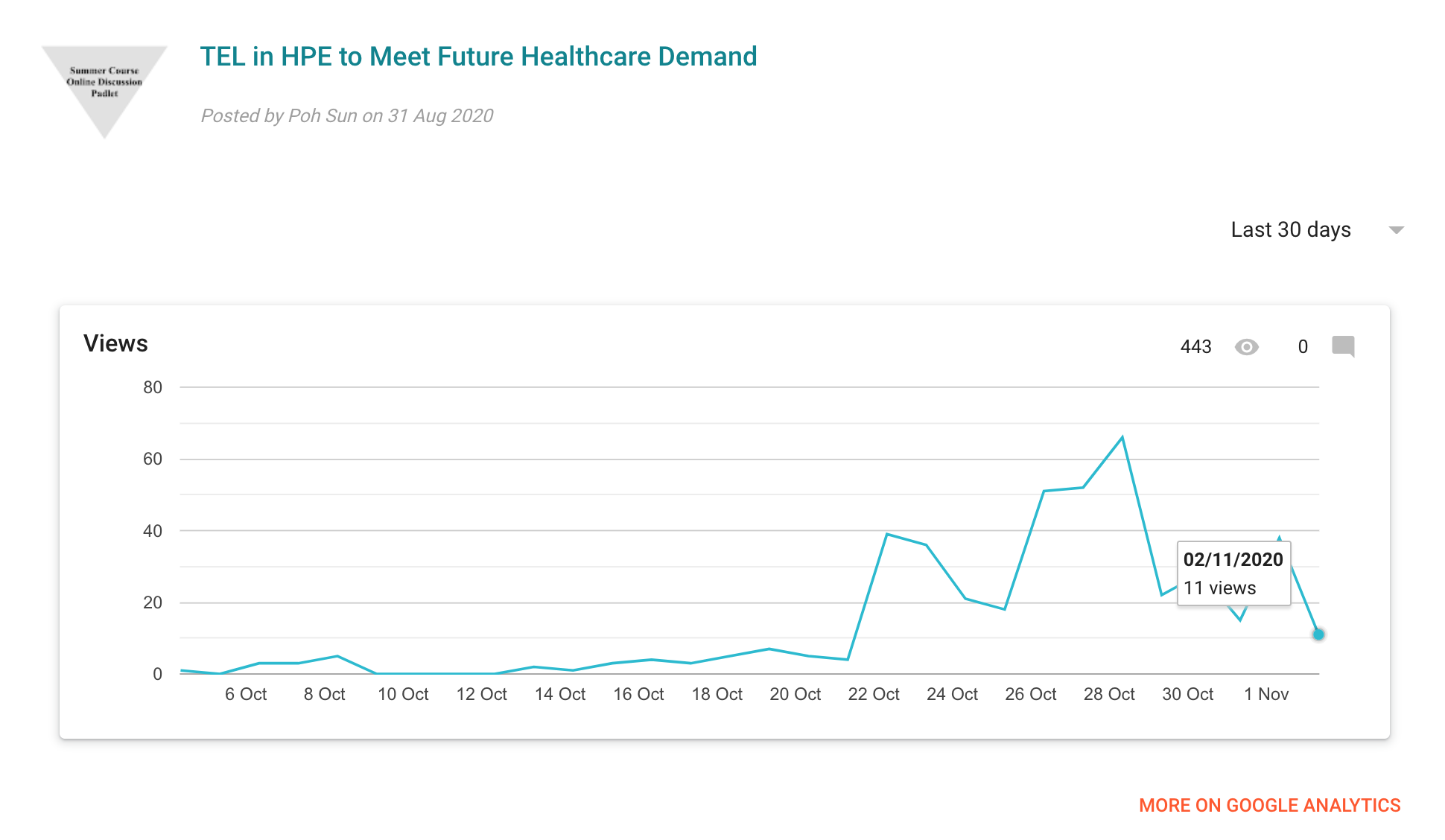
Above shows online engagement with Blog content as of 9 November 2020 @ 0608am (Singapore time)
(Quantitative analytics)


above and below as of 0647am (Singapore time)
on 3 November 2020

Goh, P.S. Learning Analytics in Medical Education. MedEdPublish. 2017 Apr; 6(2), Paper No:5. Epub 2017 Apr 4. https://doi.org/10.15694/mep.2017.000067
Samarasekera DD, Goh PS, Lee SS, Gwee MCE. The clarion call for a third wave in medical education to optimize healthcare in the twenty-first century. Medical Teacher (accepted for publication, July 2018; epub 9 October 2018).
(see section on Learning Analytics and Digital Scholarship within article)
https://scholarbank.nus.edu.sg/handle/10635/151005 (access copy via NUS Scholarbank)


(Padlet link)
or post and comment directly on Padlet below
⬇️
⬇️



above from
("HI" = Human Intelligence, "AI" = Artificial Intelligence)


2020 Virtual Summercourse: Health 4.0 Managements and Technologies for Improving Health Services in Developing Countries, which is organized by Faculty of Medicine, Public Health and Nursing in collaboration with Faculty of Pharmacy and Faculty of Dentistry, Universitas Gadjah Mada (UGM).
https://fk.ugm.ac.id/en/department-of-medical-education/
http://fk.ugm.ac.id/en/summer-winter-course-2/
https://fk.ugm.ac.id/en/department-of-medical-education/
http://fk.ugm.ac.id/en/summer-winter-course-2/





⬇️
🔄
"All great masters are chiefly distinguished by the power of adding a second, a third, and perhaps a fourth step in a continuous line. Many a man has taken the first step. With every additional step you enhance immensely the value of you first." - by Ralph Waldo Emerson
#FOAMed
Sandars, J., Correia, R., Dankbaar, M., de Jong, P., Goh, P.S., Hege, I., Masters, K., Oh, S.Y., Patel, R., Premkumar, K., Webb, A., Pusic, M. (2020). 'Twelve tips for rapidly migrating to online learning during the COVID-19 pandemic'. MedEdPublish, 9, [1], 82, https://doi.org/10.15694/mep.2020.000082.1
Goh P.S, Sandars J. (2020) 'A vision of the use of technology in medical education after the COVID-19 pandemic', MedEdPublish, 9, [1], 49, https://doi.org/10.15694/mep.2020.000049.1
🔄
⬇️
Dear students,
From Indonesia, and joining us from the Netherlands. Welcome also to the Masters student joining this Summer Course (as well as my teaching colleagues at UGM, and from Flinders University).
Thank you to the faculty at UGM for planning this Summer Course, and to you, the students, for participating in the program.
All the material that I plan to share with you for my segment of this Summer Course can be accessed from, and will be presented by me from, this blog. Think of this blog as a "buffet", with both granular "digital ingredients", "partially prepared food items", "ready to eat" and "ready to heat up food items", and a very wide variety of "cooked food dishes", prepared for you to eat, and consume. The idea is to present the widest possible digital content, curated for the topic and theme of my course segment. This will allow you to survey, sample, taste, take small nibbles, small bites (bytes), small plates, or full servings of the digital content that you feel you need, are relevant for you, and what you are "hungry" for. Like a buffet, you can keep coming back to sample, try out, and consume more digital content. Like eating, the best strategy is not to eat everything at one go, at the same time. Pace yourself, take what you need. This digital buffet will always be there. Accessible 24/7.
Your engagement with this content is a "metaphor", a case-study example, of how technology can be used to provide a customised, individual, learning and training experience. Please reflect on your interaction and approach to this content. And my role - the role of the instructor, teacher, guide, curator, content creator, and coach. Please also reflect on your approach to learning and training; and what best practices in learning, teaching, and learning science are; and how elements of learning science have been incorporated in this engagement process with you.
For those of you who might feel that this takes an enormous amount of time, energy, effort and commitment; from both student, and the teacher; please reflect on how pacing yourself, an extended engagement process, and cumulative effort, helps anyone complete a (digital) journey, whether travelling, learning and training, or as a professional. The content once created and curated (with attribution, properly cited, following best practices of digital use, re-use, professionalism, digital privacy, and accepted norms and guidelines for online practice); can be accessed (globally) 24/7, by both students, peers and the content creator/curator/instructor. Therefore front loaded enormous time commitment and effort by the content creator/curator/instructor can be re-used, and added to in the future; with much less additional effort. And is visible, accessible, and assessable evidence of "what you teach with, and assess on", as well as intermediate and final outcomes of a teaching, learning, and training process.
I hope you enjoy this learning journey. I have really enjoyed preparing this material for you (over many, many weeks, at all times of the day and night, on weekdays, and weekends; as a personal, and professional passion project). I truly and deeply believe that being both a clinical practitioner, and teacher working with the next generation of health professionals, and with my teaching colleagues in faculty development, is the greatest honour and privilege; and of both value, and impact, for the present, and future.
➡️Please start your engagement with the material by reviewing a relevant question (to you), and reviewing the personalised recommended pre-reading content. Please take notes, and personal reflections on this content, and share this. Engage with discussions with your fellow students, and with the faculty. I look forward to our asynchronous and "live" discussion. See you "live" at my lecture.
➡️As there are over 100 students attending this course, I will be progressively adding a personalised recommendation / preparation for each student / each question over the next few days, before the official start of the Summer Course on Monday 26 October 2020; and progressively in the weeks leading up to my "lecture" on the 9th November 2020 (or at the very least will try my best, my clinical work, family commitments and sleep permitting). For very keen, enthusiastic students who have accessed this webpage early, please feel free to survey, sample, dip in, try out, and review this "buffet" of digital content. You might want to start with the section immediately before this message. Do also take some time to relax, and enjoy your upcoming weekend!
With warmest regards,
Poh-Sun (23 October 2020 @ 0638am)
(I have requested the course organisers to share this blogpost with the Summer Course participants from today, Friday 23 October 2020)
more of my professional background is on this blogpost - https://medicaleducationelearning.blogspot.com/2017/09/sotl-in-meded.html
my publications - https://medicaleducationelearning.blogspot.com/2017/09/meded-peer-reviewed-publications.html
the pedagogy behind using a blog as an integrated eLearning tool and platform is described in the following article
Goh, P.S. Using a blog as an integrated eLearning tool and platform. Med Teach. 2016 Jun;38(6):628-9. Epub 2015 Nov 11.
http://www.ncbi.nlm.nih.gov/pubmed/26558420 (to access abstract)
https://scholarbank.nus.edu.sg/handle/10635/140814 (to access full article)
Goh PS, Sandars J. (2019). Digital Scholarship – rethinking educational scholarship in the digital world, MedEdPublish, 8, [2], 15, https://doi.org/10.15694/mep.2019.000085.1
Goh, P.S. The value and impact of eLearning or Technology enhanced learning from one perspective of a Digital Scholar. MedEdPublish. 2016 Oct; 5(3), Paper No:31. Epub 2016 Oct 18.
http://dx.doi.org/10.15694/mep.2016.000117
P.S: My 'lecture' on 9 November 2020, will basically focus on fundamentals of TeL in MedEd (10 Slides).
After this short presentation, I will take 'live' questions, and also discuss questions brought up on the pre-course Google Docs survey further (see screenshots section above, and selected questions highlighted in question 💬below).
(URL for my 10 slide lecture - please pay close attention to the sequence of key words and phrases)


Goh, P.S., Sandars, J. (2019). Using Technology to Nurture Core Human Values in Healthcare. MededPublish, 8, [3], 74, https://doi.org/10.15694/mep.2019.000223.1


Masters K, 2020, 'Artificial Intelligence developments in medical education: a conceptual and practical framework', MedEdPublish, 9, [1], 239, https://doi.org/10.15694/mep.2020.000239.1
 https://medicaleducationelearning.blogspot.com/2020/07/training-in-digital-literacy-and.html


➡️Q9. https://blogger.googleusercontent.com/img/b/R29vZ2xl/AVvXsEgQyhM6S6ZvZTz-h6m6jHQTTs7oEtdGFpifKDQV1QXWgIRYqjamHaBGlztjJsHi3l65bCSqXRUZDBSvkLPr8sYqSDuw69-tPd4xDHJvPxXf-n9YlaqDroTY6uhfhndpMMh7Pj6WBp4RQjg/s1422/UGM+2020+Digital+Literacy.png (The importance of digital literacy and digital skills in your current learning and future professional practice. To also learn to add value as a 'human', in a technology infused environment)


⬇️
⬇️

➡️General Approach/'Pedagogy' used for customised individual preparation/pre-reading based on submitted survey question response http://dx.doi.org/10.15694/mep.2017.000010
Goh, P.S., Sandars, J. Insights from the culinary arts for medical educators. MedEdPublish. 2017 Jan; 6(1), Paper No:10. Epub 2017 Jan 18.
http://dx.doi.org/10.15694/mep.2017.000010

above from
Goh, P.S. A series of reflections on eLearning, traditional and blended learning. MedEdPublish. 2016 Oct; 5(3), Paper No:19. Epub 2016 Oct 14.
http://dx.doi.org/10.15694/mep.2016.000105
Sandars, J., Correia, R., Dankbaar, M., de Jong, P., Goh, P.S., Hege, I., Masters, K., Oh, S.Y., Patel, R., Premkumar, K., Webb, A., Pusic, M. (2020). 'Twelve tips for rapidly migrating to online learning during the COVID-19 pandemic'. MedEdPublish, 9, [1], 82, https://doi.org/10.15694/mep.2020.000082.1
see also for Q10. https://www.instagram.com/p/CGWO6DNHiO-/ ('Bootstrap Innovation' post on Instagram), and https://www.instagram.com/p/B-svfApnehE/ (use what is 'at hand')
Poh-Sun Goh (2016-03-16). eLearning or technology enhanced learning in medical education—Hope, not hype. Medical Teacher 38 (09) : 957-958. ScholarBank@NUS Repository. https://doi.org/10.3109/0142159X.2016.1147538
Goh, P.S. eLearning in Medical Education - Costs and Value Add. The Asia Pacific Scholar (TAPS). Published online: 2 May, TAPS 2018, 3(2), 58-60. DOI: https://doi.org/10.29060/TAPS.2018-3-2/PV1073
Cecilio-Fernandes D, Parisi M, Santos T, Sandars J, 2020, 'The COVID-19 pandemic and the challenge of using technology for medical education in low and middle income countries ', MedEdPublish, 9, [1], 74, https://doi.org/10.15694/mep.2020.000074.1
(Technology Enhanced Learning in Medical Education - Why, Before What, and How)
Goh, P.S. A series of reflections on eLearning, traditional and blended learning. MedEdPublish. 2016 Oct; 5(3), Paper No:19. Epub 2016 Oct 14.
http://dx.doi.org/10.15694/mep.2016.000105


Goh, PS. 'Medical Educator Roles of the Future'. Medical Science Educator. Online publication 30 September 2020. https://doi.org/10.1007/s40670-020-01086-w
Poh-Sun Goh, John Sandars (2019-01-16). Increasing tensions in the ubiquitous use of technology for medical education. Medical Teacher 41 (6) : 716-718. ScholarBank@NUS Repository. https://doi.org/10.1080/0142159X.2018.1540773
see also
⬆️
⬆️
➡️Keeping up with the news, current trends, and topics
e.g.
⬇️
⬇️
🔄
🔄
--------------
Pre-lecture comments and preparation:
Dear students,
Pre-lecture comments and preparation:
Dear students,
The importance of digital literacy and digital skills in your current learning and future professional practice. To also learn to add value as a 'human', in a technology infused environment.
'Why, before What and How'. Why is digital literacy important for you, as undergraduate students, and in your future professional practice? To become more efficient and effective learners as undergraduates. To learn, unlearn, and re-learn as part of a continuing education and training process as practicing professionals in the future. To keep up to date, to anticipate and prepare for incremental, and transformational changes to healthcare practice. To develop knowledge, skills, attitudes-convictions-informed judgements and perspectives on healthcare practice. To develop digital literacy, and high level skills to navigate a technology enabled, technology mediated, and technology embedded future. To learn to not only work with AI and machine learning, but to learn to work with and add value to AI and machine learning and robotic systems. To also focus on 'soft skills', emphasising human communication, understanding and empathy; to add value as humans, in a technology infused environment.
Poh-Sun Goh, 22 September 2020 @ 0721am

Mesko, B., Győrffy, Z., & Kollár, J. (2015). Digital Literacy in the Medical Curriculum: A Course With Social Media Tools and Gamification. JMIR medical education, 1(2), e6. https://doi.org/10.2196/mededu.4411
Oliver, R., Kersten, H., Vinkka‐Puhakka, H., Alpasan, G., Bearn, D., Cema, I., Delap, E., Dummer, P., Goulet, J.P., Gugushe, T., Jeniati, E., Jerolimov, V., Kotsanos, N., Krifka, S., Levy, G., Neway, M., Ogawa, T., Saag, M., Sidlauskas, A., Skaleric, U., Vervoorn, M. and White, D. (2008), Curriculum structure: principles and strategy. European Journal of Dental Education, 12: 74-84. doi:10.1111/j.1600-0579.2007.00482.x
Example - EMD Case Study
from
🔄
🔄
🔄
If you have little time, (and interest in the topic), please read the following open access article before the lecture, AND both reflect on, and take notes on how the key messages in this article might be helpful in your current and future practice.
Goh P.S, Sandars J. (2020) 'A vision of the use of technology in medical education after the COVID-19 pandemic', MedEdPublish, 9, [1], 49, https://doi.org/10.15694/mep.2020.000049.1
If you are an undergraduate in medicine, nursing, allied health sciences, recommend you focus on the content in the following blog, and article -
Henderson, M., Selwyn, N., & Aston, R. (2017). What works and why? Student perceptions of 'useful' digital technology in university teaching and learning. Studies in Higher Education, 42(8), 1567-1579. https://doi.org/10.1080/03075079.2015.1007946
Please identify which sections in these pieces resonate with you. And reflect the usefulness, and value-add that technology has for your learning and training.
If you have more time, do explore the resources available on the blog below.
Vasavda, C., Ho, B.K. & Davison, A. Socially Distant Medical Education in the Face of COVID-19. Med.Sci.Educ. (2020). https://doi.org/10.1007/s40670-020-01127-4
Sriharan, A. Teaching Online: Tips for Engaging Students in Virtual Classrooms. Med.Sci.Educ. (2020). https://doi.org/10.1007/s40670-020-01116-7
Goldenberg, M.N., Hersh, D.C., Wilkins, K.M. et al. Suspending Medical Student Clerkships Due to COVID-19. Med.Sci.Educ. 30, 1273–1276 (2020). https://doi.org/10.1007/s40670-020-00994-1
Hoernke, K., McGrath, H., Teh, J.Q. et al. Virtual Learning Innovations for Continuing Clinical Education during COVID-19. Med.Sci.Educ. (2020). https://doi.org/10.1007/s40670-020-01090-0
Yilmaz, Y., Lal, S., Tong, X.C. et al. Technology-Enhanced Faculty Development: Future Trends and Possibilities for Health Sciences Education. Med.Sci.Educ. (2020). https://doi.org/10.1007/s40670-020-01100-1

⬇️
🔄
If you are very interested in this topic, and are able to commit the time, do review the material on the 5 blogs below section BEFORE the lecture, and both reflect on, and take notes on how the key messages might be helpful in your current and future practice.
➡️➡️➡️➡️➡️ https://medicaleducationelearning.blogspot.com/2020/07/training-in-digital-literacy-and.html
(then do this - part 5, after below part 4)
➡️➡️➡️➡️ https://medicaleducationelearning.blogspot.com/2020/06/medical-education-disrupted-by.html
(then do this - part 4, after below part 3)
➡️➡️➡️ https://medicaleducationelearning.blogspot.com/2020/06/transformational-change-in-scholarship.html
(then do this - part 3, after below part 2)
➡️➡️ https://medicaleducationelearning.blogspot.com/2020/04/iamse-2020-plenary-presentation-medical.html
(then do this - part 2, after below part 1, the foundation)
➡️ https://medicaleducationelearning.blogspot.com/2020/03/technology-enhanced-learning-cenmed.html
(start here - part 1, the foundation)
I will take live Q and A during my lecture.
With warmest regards,
--------------

Link to embedded video of my "micro-lecture" (on Google Drive, visible on your mobile device, laptop or desktop computer)
⬇️
🔄
TEL in HPE to Meet Future Healthcare Demand
➡ Why before What and How. Role of Technology enhanced learning (TEL) in formal learning and training, informal learning, and just-in-time learning; in the home, classroom, and workplace; in undergraduate, postgraduate, and lifelong learning. TEL to build knowledge, skills and attitudes. In competency based training (an evolution from time based training). To scale. To expand access. To extend the reach of instructors, associations and institutions. To support self-directed, and instructor facilitated (in future part AI facilitated) learning.
➡ AI, machine learning, mobile technology, VR/AR/mixed reality, and tele-health are increasingly being used to expand access to healthcare, and extend the reach of healthcare practitioners.
Poh-Sun Goh, 1 September 2020 @ 0650am, revised 1248pm


My presentation will have have several take-aways, which are outlined below:
Use of TeL in Med Ed - for Undergraduate students, Instructors, and future Practitioners
Poh-Sun Goh
Messages for undergraduate students:
Please reflect on key ideas from the following blog, and article, and their relevance and application to you. How can technology support and enhance your learning and training? Do focus on what your learning objective, and purpose is. 'Why, before What, and How'. To answer a question, look for information, assess the quality, accuracy and relevance of this information, learn a skill or technique, get feedback on your knowledge and skill development and performance, develop insights, feelings and a 'feel' for themes and topics in health professions education and practice. TeL in MedEd to help and assist you, to 'Know, Do and Feel'.
Henderson, M., Selwyn, N., & Aston, R. (2017). What works and why? Student perceptions of 'useful' digital technology in university teaching and learning. Studies in Higher Education, 42(8), 1567-1579. https://doi.org/10.1080/03075079.2015.1007946
How do you evaluate and assess the relevance, utility and quality of the content you find? Have a look. Listen. Form and impression. Use your judgement. Look at reviews. Recommendations. Ask for recommendations. Consult your peers, and instructors. What did they find useful. What do they recommend, for you.
Let's use an analogy. What do you do when looking for a place to eat? Travel to? Stay? What and how do you search for information? Online, and in person? Where do you look? Who do you ask? Peers and colleagues who have dined, travelled and stayed in, and recommend options. Who know you, your requirements, and tastes. How do you translate and transfer this search, and 'learning' process to your educational, training and clinical practice?
Messages for students, as future instructors: 'See one, Do one, then Teach one', 'To teach is to learn twice over - Joseph Joubert'
Kotsis, S. V., & Chung, K. C. (2013). Application of the "see one, do one, teach one" concept in surgical training. Plastic and reconstructive surgery, 131(5), 1194–1201. https://doi.org/10.1097/PRS.0b013e318287a0b3
Technology is a tool. What is the task, or 'job' required? What do you have at hand (as instructor)? What do students have access to? What is the role of the instructor?
What do you want your student or trainee to know, do or feel? What do you as instructor intend to do? To share knowledge, demonstrate a skill, engage students in a discussion? Facilitate discussion between, and with students? Give feedback?
How do you know a student has learnt successfully? Focus on the learning process, pathway, intermediate and final outcomes of learning. Make these visible, for reflection, feedback, assessment (both formative and summative), evaluation, and scholarship (peer review, critique, assessment, feedback, to build upon).
What are best practices in using TeL in MedEd? What does learning science tell us? To teach effectively. To learning efficiently and effectively.
Final Thoughts. Focus on usefulness, relevance, usability of content, training tools, platforms and processes. Be informed by learning science, and best practices. Read widely, get training, and feedback. Be scholarly, and a scholar.
Performance drives Learning from Poh-Sun Goh
for above, see additional notes related to Slideshare post on Slideshare post webpage
at bottom of Slide, after date of posting
TEL is one method (to assist efforts to) '....rapidly expand the clinical workforce'.
above quote from
Goh P.S, Sandars J. (2020) 'A vision of the use of technology in medical education after the COVID-19 pandemic', MedEdPublish, 9, [1], 49, https://doi.org/10.15694/mep.2020.000049.1
Sandars, J., Correia, R., Dankbaar, M., de Jong, P., Goh, P.S., Hege, I., Masters, K., Oh, S.Y., Patel, R., Premkumar, K., Webb, A., Pusic, M. (2020). 'Twelve tips for rapidly migrating to online learning during the COVID-19 pandemic'. MedEdPublish, 9, [1], 82, https://doi.org/10.15694/mep.2020.000082.1
Gert J. J. Biesta & Marije van Braak (2020) Beyond the Medical Model: Thinking Differently about Medical Education and Medical Education Research, Teaching and Learning in Medicine, DOI: 10.1080/10401334.2020.1798240
FOUR-COMPONENT INSTRUCTIONAL DESIGN (4C/ID)
Artino, Anthony R. Jr., PhD; Jones, Kenneth D., PhD. Self-Regulated Learning—A Dynamic, Cyclical Perspective. AM Last Page, Academic Medicine: July 2013 - Volume 88 - Issue 7 - p 1048 doi: 10.1097/ACM.0b013e3182953763
'Preparation for future learning can be supported through specific educational approaches ... Broadly, these approaches suggest that for PFL and subsequent adaptive expertise, education must emphasize (1) understanding rather than performance, (2) emphasize struggle and risk taking, and (3) support meaningful variation ... can put clinicians on the path to becoming quick and efficient problem solvers when needed and effective innovators in the face of novelty complexity and ambiguity.'
above quote from
Mylopoulos M, Kulasegaram K, Woods NN. Developing the experts we need: Fostering adaptive expertise through education. Journal of Evaluation in Clinical Practice. 2018 Jun;24(3):674-677. DOI: 10.1111/jep.12905.
➡️➡️➡️➡️➡️ https://medicaleducationelearning.blogspot.com/2020/07/training-in-digital-literacy-and.html
(then do this - part 5, after below part 4)
➡️➡️➡️➡️ https://medicaleducationelearning.blogspot.com/2020/06/medical-education-disrupted-by.html
(then do this - part 4, after below part 3)
➡️➡️➡️ https://medicaleducationelearning.blogspot.com/2020/06/transformational-change-in-scholarship.html
(then do this - part 3, after below part 2)
➡️➡️ https://medicaleducationelearning.blogspot.com/2020/04/iamse-2020-plenary-presentation-medical.html
(then do this - part 2, after below part 1, the foundation)
➡️ https://medicaleducationelearning.blogspot.com/2020/03/technology-enhanced-learning-cenmed.html
(start here - part 1, the foundation)
Google search for 'TEL in HPE to Meet Future Healthcare Demand'
https://www.mckinsey.com/industries/healthcare-systems-and-services/our-insights/promoting-an-overdue-digital-transformation-in-healthcare
A robot wrote this entire article. Are you scared yet, human? (Guardian, 8 Sep 2020)
Goh, P.S. Technology enhanced learning in Medical Education: What’s new, what’s useful, and some important considerations. MedEdPublish. 2016 Oct; 5(3), Paper No:16. Epub 2016 Oct 12.
see also