Monday, 23 September 2013

Artifacts from an educational portfolio (examples)


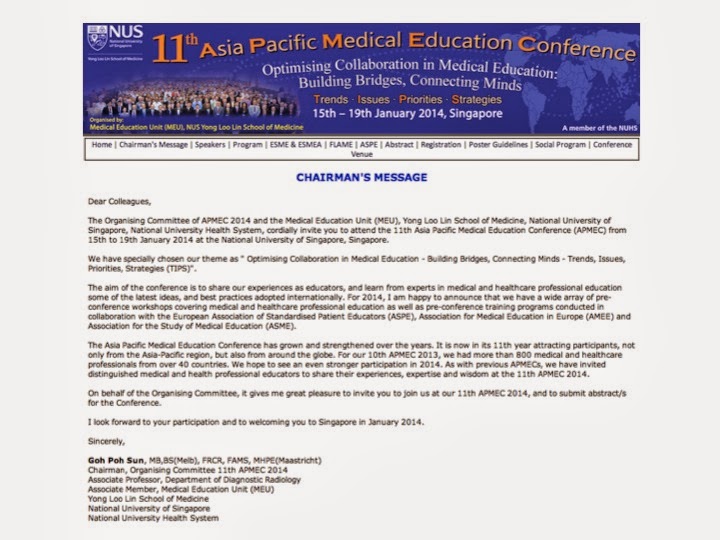
Workshop registration area, PGPR workshops venue, 11th APMEC 2014


ESME workshop, 11th APMEC


Creativity in medical education workshop, 11th APMEC


Leading educational change workshop, 11th APMEC


Asia Pacific collaboration in medical education meeting @ 11th APMEC 2014


Singapore International Foundation – Enhancing Health Professional Education in Sri Lanka (October 31st to 2nd November)
31st October 2013 (New Biochemistry Lecture Theatre Colombo Medical Faculty)


Arrive Colombo - early morning Thursday 31th

9.30am-      Arrive Colombo Medical Faculty

10 am -       Medical School Meeting Dean (Professor Sally Chan, Dujeepa and SIF)

10.30 am – Welcome Introduction

Sharing of past work and progress

11 am -       Summary of EPAs and introduction to Blueprints

12 noon -    Q and A

12.30pm-    Lunch

2.00 pm –    Training of future nurse practitioners in an Interpeorfessional patient/practice care settings (Lecture – Large Group) Professor Sally Chan, Professor of Nursing, Alice Lee Centre for Nursing, Yong Loo Lin School of Medicine, National University of Singapore.

3.00 pm –    Teaching for effective learning in Clinical Education (Lecture – Large Group) Dr. Dujeepa D. Samarasekera, Director Medical Education Unit, Yong Loo Lin School of Medicine, National University of Singapore.

4.00 pm –    Q and A

4.30pm-      Close of session

1st Friday November 2013 (Faculty Boardroom, Colombo Medical Faculty)

9am –          Introduction

9.30am –     Technology support in teaching-learning Assoc Prof Goh Poh Sun, Dept of Diagnostic Imaging and Associate Medical Education Unit, Yong Loo Lin School of Medicine, National University of Singapore. (Web connecting from Singapore)

10.30am     Tea

11am          Incorporating Interprofessional Learning

12 noon      Lunch

1pm            Assessment in Clinical Years -Best evidence contemporary practice

2.00 pm      Working on blueprints

3.00 pm                Tea

3.30pm       Sharing of blueprints

4.00            Future work plans and schedules sharing

4.30            Close

2nd November (Saturday)

9am            Discussions with key leadership regarding progress

10am          Discussions with core clinical educators.

12noon       Close of activities

10 pm         Departure to Singapore


Three takeaways for Nov 1 conference call with Sri Lankan educators on Technology Enhanced Learning @ 12 noon, Nov 1, 2013, Friday

1. (e)Learning - the quality of the educational content, and teaching pedagogy is the key (focus on supporting learning ... and the role of the teacher)

2. use open education resources (OERs), and systematically build up your localised digital knowledge repository

3. focus on faculty development, systematic, planned, with periodic feedback, evaluation and reflection on the process ... and outcomes


_______________________________________

Brief outline of Nov 1 discussion with educators from Sri Lanka

A. Role of Technology Enhanced Learning (TEL) or (e)Learning

http://mededworld.org/reflections/reflection-items/September-2013/(e)Learning.aspx


B. My current activities in TEL

http://medicaleducationelearning.blogspot.sg/2013/09/artefacts-from-educational-portfolio.html


C. Background in TEL

http://medicaleducationelearning.blogspot.sg/2012/10/conference-papers_4167.html

http://medicaleducationelearning.blogspot.sg/2012/10/workshops-symposia-invited-presentations_5391.html


D. Short CV

http://medicaleducationelearning.blogspot.sg/2012/06/goh-poh-sun-mbbsmelb-frcr.html

http://www.linkedin.com/pub/poh-sun-goh/22/45b/b16

http://www.slideshare.net/dnrgohps/documents


                                AMEE 2012 Annual Report (see report from eLearning committee)


Conference call on Feb 26, 2014 @2130hrs to plan the eLearning pre-conference program for AMEE 2015 in Glasgow (above)

and on May 23, 2014 @ 2030hrs (below)


                                                http://www.amee.org/amee-committees/elearning


Under editorial review (above)


M3 (surgery) undergraduate case review session: 1245 to 1345hrs, Oct 23, 2013, Conference Room, Radiology Department, Level 2, NUH (above)


Slides for M1 lecture (Chest and Lungs): 11am to 12noon, MD 6, LT 35; Oct 25, 2013 (above and below)


Slides for M2 lecture title slide above, with rest of slides on website below (Imaging of Respiratory Tract Disorders): 0930 to 1030am, MD 6 LT 35; Thursday, Nov 21, 2013


Using the flipped classroom model in medical education: 12noon to 2pm, Symposium rooms 2 & 3, Clinical Research Centre (CRC), Block MD 11, 10 Medical Drive, YLL SOM, NUS on Dec 10, 2013


                               Maastricht SHE Annual Report 2012 (see MHPE graduates page)


Involvement in the faculty development program, Medical Education Unit
National University of Singapore (above)


First scholarly project milestones for R1 residents I am supervising (AK above, and HY below), October, 2013


Working with R2 ophthalmology residents (as part of preparation for monthly clinical radiology radiology multidisciplinary case conference: see example of outcome below)


                                          http://www.shbc.com.sg/the-congress/welcome/


                                    http://www.cdtl.nus.edu.sg/tel2013/docs/programme.pdf


                                                              ePortfolio tips


Saturday, 21 September 2013

Educational IT - Three ideas, one vision


(e)Learning

(e)Learning

Summary:

Learning is at the heart of what we do. Technology can facilitate, customise, amplify. Note the small (e), and big L in (e)Learning. The quality of the content matters. As educators, lets create great content, share it, or curate it. The internet and mobile technology connects.

Article:

My opening statement in the eLearning workshops that I run for faculty development in Singapore under the auspices of the Medical Education Unit is (e)Learning --> with emphasis on the Learning/our students learning needs/our learning objectives/curricula and assessment to promote learning.

Despite this, the (e) does have some educational features that distinguish it from previous innovations in learning technology - the stick in the sand, chalk, overhead projector, printing press, VHS tape, VCD ...
i.e. access, reusability, hyperlinking, embedding, broadcasting, narrowcasting (targeted access), granular curricular construction, distributed crowd sourcing/co-creation to name a few.

At the moment, I walk around with a 5.8 inch Samsung phablet in left front jeans pocket, iPhone 5 in right front jeans pocket, HTC smartphone with keyboard in left jeans backpocket (while waiting for the next incarnation of wearable computing/cloud storage and processing) ... however ... whenever I pull out one of these devices to teach on, or illustrate with ... the first point I make is that it is the digital content which I am accessing which is important, NOT the device ... and the purpose I am accessing the resource for.

I truly believe that curated digital repositories, containing the most basic digital elements of "what" we teach with, and "material" we assess on defines and characterizes what we do ... breadth, range and depth of material/case based scenarios.

We teach with analogies ... and share stories and lessons.

To the current generation of students ... the technology recedes into the background ... it is just there ... their focus is on getting on with learning and connecting.

The quality of the content matters. As educators, lets create great content, share it, or curate it.

The internet and mobile technology connects.


Google Inc. (Google) is a global technology company focused on improving the ways people connect with information. 
Role of Google in our digital future (LinkedIn post, September 2013)

Technology matters, but teachers matter most of all (Heng Swee Keat)

http://www.bbc.com/capital/story/20130722-university-of-www

http://www.bbc.com/future/story/20121123-can-schools-survive-the-web-age/all


http://www.bbc.com/capital/story/20131025-dont-get-left-behind-at-work


http://www.oxfordmartin.ox.ac.uk/downloads/academic/The_Future_of_Employment.pdf


15 year olds in Asia are better problem solvers than in the US (CNN)

What can Asian schools teach the rest of the world (CNN)


http://www.technologyreview.com/view/520231/google-x-display-guru-says-wearable-computing-is-unstoppable/


View to a skill

10 Strategies Quick Learners Use To Pick Up Anything

http://www.cnet.com/news/meet-the-teen-aiming-to-breathe-life-into-global-it-education-with-thinkspace/

http://www.forbes.com/sites/netapp/2014/02/10/sales-human-factor/

"Information comes to you as you need it" (Sergey Brin)

http://www.economist.com/blogs/graphicdetail

http://recode.net/2014/04/14/how-mobile-first-became-mobile-only-in-the-emerging-world/

http://www.businessinsider.sg/google-ceo-larry-page-change-the-world-2014-3/#.UzBmtK2SyjI


http://www.slideshare.net/barbaranewland/blended-learning-overview-updated-february-2014

http://www.slideshare.net/barbaranewland/blended-learning-effective-efeedback-30940375


http://blog.slideshare.net/2014/02/24/nancy-duarte-slidedocs-the-new-form-of-business-communication/


Seven essentials of good infographic design

http://www.scoop.it/t/eclectic-technology


https://flipboard.com/magazines/#tech-science


The global teacher

http://www.bbc.com/future/story/20131015-the-classroom-in-the-clouds

http://www.scoop.it/t/21st-century-learning-and-teaching


http://blogs.wsj.com/personal-technology/2014/03/17/ava-robot/

Walking improves creative thinking


As education evolves, so must universities  ("swirling", "continual lifelong learning interspersed with work", "relevancy, reinvention, re-learn, re-skill", role of universities - "helping students choose, assess and certify multiple learning paths", "lecturers as academic coaches - helping students construct an academic path that is coherent, and has both breadth and depth")

http://www.sim.edu.sg/news/newsclippings/pages/newsclippingsoverview.aspx

http://www.sim.edu.sg/pages/index.aspx


http://mededworld.org/Webinars/Webinar-Items/The-things-we-know,-the-things-we-think-we-know-bu.aspx


http://mededworld.org/Webinars/Webinar-Items/AMEE-MEW-Webinar-75-How-to-personalise-learning-b.aspx


Google search tips

http://www.tuaw.com/2014/01/27/inkredible-for-ipad-is-an-excellent-note-taking-app/


Sharing images in wikis, supporting small group work

http://www.mediawiki.org/wiki/Mobile_design/Uploads#Insert_image_directly_into_article


A plea for "close learning"

http://www.nytimes.com/2014/04/27/travel/snapping-good-photos-with-your-phone.html#

http://instagram.com/koci


Be FAIR to students: Four principles that lead to more effective learning (Harden, 2012)

Be FAIR to stuents (pdf)

http://www.mededworld.org/News/News-Articles/Poll-Results-Harden-has-described-the-Fair-princip.aspx


NHS Hack Day Cardiff (January 2014)


MOOCS (plus and minuses), e.g. MBA


SPOCS (post MOOC era)

http://blogs.ft.com/tech-blog/2014/02/moocs-in-transition-not-so-massive-open-or-even-online/?


http://www.insidehighered.com/views/2013/01/24/essay-what-professors-can-learn-moocs

+

http://allmoocs.wordpress.com/2013/01/25/a-critical-review-of-andrew-ngs-learning-from-moocs/

http://ideaedu.org/research-and-papers/pod-idea-notes-instruction/idea-item-5-formed-teams-or-discussion-groups


Andrew Ng, Coursera, see Straits Times, Sunday, March 16, 2014 interview - "There is no substitute for a good teacher", section "Think", page 46


MOOCs - Threat or Opportunity

http://www.stanforddaily.com/2012/10/19/andrew-ng-champions-online-education-as-the-great-equalizer/


http://www.slideshare.net/mbrownz/the-new-openness-movement-unpacking-the-hype-from-the-hope


Google, memory & learning


Content Curation World

         How to be an effective content curator


25 things you might not know about the world wide web

http://www.bloomberg.com/news/2014-03-12/your-job-taught-to-machines-puts-half-u-s-work-at-risk.html

http://www.bloomberg.com/infographics/2014-03-12/job-automation-threatens-workforce.html


Library of the future

Why kids prefer print

Print vs Digital Reader's comment

Print vs Digital News

http://www.permanencematters.com/the-case-for-books/

http://www.theguardian.com/books/2013/nov/25/young-adult-readers-prefer-printed-ebooks

Print is here to stay

https://www.surveymonkey.com/blog/en/blog/2013/03/25/print-books-vs-e-books-whats-the-future-of-reading/

http://mashable.com/2013/01/16/e-books-vs-print/

http://www.joanganzcooneycenter.org/wp-content/uploads/2012/07/jgcc_ebooks_quickreport.pdf

http://libraries.pewinternet.org/2012/04/13/print-books-vs-e-books-which-is-better-for-what/

http://www.publishersweekly.com/pw/by-topic/digital/retailing/article/58668-gauging-the-digital-divide.html

http://dabalepublishing.blogspot.sg/2013/05/ebook-versus-print-why-battle.html

E-Book vs P-Book

Hybrid reading (Washington Post)

"The difference between surfing the web and reading print is the difference between the visual rush of jet skiing and the immersive experience of scuba diving" (Carr, 2008)

"We are not only what we read, we are how we read" (Wolfe, 2007)

The future of brain implants


http://tech.fortune.cnn.com/2013/12/26/the-problem-with-paid-content-you/

http://readerspost.straitstimes.com/just-one-view/print-must-partner-web-or-perish-20131209

eLearning in Commonwealth Asia - Implications and Impact (Commentary)

http://www.theguardian.com/education/2011/feb/21/endangered-languages-research-project


http://www.businessinsider.com/scientists-are-building-computers-that-can-learn-and-adapt-2013-12

http://www.businessinsider.com/samsung-display-concept-video-2013-12


http://www.singapolitics.sg/views/education-evolves-so-must-universities

          http://en.wikipedia.org/wiki/List_of_universities_and_colleges_in_Singapore

http://chronicle.com/blogs/next/2012/03/08/the-student-swirl/

         Clifford Adelman, Ph.D: profile

http://flex.wisconsin.edu/wall-street-journal-features-uw-flexible-option/

UW Flexible Option – If You’re Competent and You Know It, Prove It and Move Forward

          Enabling Student Swirl: A Community College/University Dual Enrollment Program


Shaking up the classroom

Design for a new college


http://tech.fortune.cnn.com/2014/03/10/apple-benedict-evans-incontext/

Keynote: Benedict Evans - InContext 2014

http://ben-evans.com/presentations/

http://cubed.fm/


Accounting principles: a business perspective, financial accounting (pdf)

Accounting principles: managerial accounting (pdf)

Principles of accounting (pdf)

Are you competent? Prove it.


Tuesday, 23 July 2013

Blank Interview Form


The purpose of these interviews and related questionnaire is to allow me to develop a deeper understanding of your learning preferences and requirements as a radiologist-in-training, and to further refine the case based teaching and learning material that has been made available to you via the learning radiology blogs. These resources can be used as part of your radiology residency program. I have a long standing interest in the use of technology enhanced learning (eLearning) in medical education and radiology training, and these short evaluation sessions will focus the content and presentation of the case based online teaching and learning material to more closely match your training requirements and learning needs.

Please note that your responses to the following interview and questionnaire will be anonymised, and any dissemination, presentation or discussion of your response, or the aggregated responses of your peers will be anonymised. Our departmental postgraduate training committee members are aware that these discussions are taking place (HOD, PG training director, Neuroradiology section chief).

(for example, as I have discussions with each of you, your responses will be reflected in the questionnaire by anonymous symbols --> @, #, ~, %, ^, &, *, +, ?, !, <, > ..... for 30 plus MOs, residents/BST/ASTs in our department)


Qualitative Evaluation

Which year of radiology residency are you in?


Tell me about your professional experience before entering radiology?


How have you found the learning experience and training environment in the radiology department?


How do you prefer to learn?


What experiences have you found most useful in your training?


Why do you find these experiences helpful?


Do you have any special requests? For example, if only the department had ____ , my training would then be perfect !


Quantitative Evaluation

Which year of residency are you in?

- MO 
- Year 1
- Year 2
- Year 3
- Year 4
- Year 5
- Year 6

How much experience have you had in neuroradiology?

- 6 weeks or less 
- 12 weeks
- 18 weeks
- 24 weeks
- 30 weeks or more


How confident are you in accurately recognising and diagnosing neuroradiology problems that you might encounter

- On call?

1- not confident
2 - somewhat confident
3 - confident that I will not miss anything major, will look up anything I don't recognise regularly
4 - very confident, but will still look up anything I am not sure of not more than once to twice a day
5 - extremely confident, rarely encounter any conditions I do not recognise, rarely look up unusual conditions


- Day to day neuroradiology rotation?

1- not confident
2 - somewhat confident
3 - confident that I will not miss anything major, will look up anything I don't recognise regularly
4 - very confident, but will still look up anything I am not sure of not more than once to twice a day
5 - extremely confident, rarely encounter any conditions I do not recognise, rarely look up unusual conditions


How well has your residency experiences prepared you for

- Call?

1 - not at all
2 - some preparation
3 - adequate preparation
4 - good preparation
5 - excellent preparation


- Day to day neuroradiology rotation?

1 - not at all
2 - some preparation
3 - adequate preparation
4 - good preparation
5 - excellent preparation


How well do you feel that review of thematic neuroradiology cases will prepare you for

- Call?

1 - not at all
2 - some preparation
3 - adequate preparation
4 - good preparation
5 - excellent preparation


- Day to day neuroradiology rotation?

1 - not at all
2 - some preparation
3 - adequate preparation
4 - good preparation  
5 - excellent preparation


Do feel that your neuroradiology training can be shortened by 20% by the deliberate use of these online cases?

Yes
No

How to you feel these cases should be organised and presented?

......


Please rate each of the following in their relative usefulness in your neuroradiology training?

5 point scale
1-not useful
2-somewhat useful
3-useful
4-very useful
5-extremely useful

Clinical experience/reporting
1-not useful
2-somewhat useful
3-useful
4-very useful 
5-extremely useful


Weekly tutorials

1-not useful
2-somewhat useful
3-useful  
4-very useful
5-extremely useful


What topics have been covered in the tutorials you have attended so far?


Pre-call preparation sessions
1-not useful
2-somewhat useful
3-useful
4-very useful
5-extremely usefulLectures

Reading books/journals (hardcopy)
1-not useful
2-somewhat useful
3-useful
4-very useful
5-extremely usefulReading journal articles(online)

Use of online databases (StatDx)

1-not useful
2-somewhat useful
3-useful
4-very useful
5-extremely useful


Use of online case repositories

1-not useful
2-somewhat useful 
3-useful
4-very useful 
5-extremely useful


When you have a problem case currently, please list the order of actions you take to solve the problem? (from 1st to 4th)

Look up StatDx 
1-not useful
2-somewhat useful
3-useful
4-very useful
5-extremely useful

Ask someone
1-not useful
2-somewhat useful
3-useful
4-very useful 
5-extremely useful 

Do a literature/online search 

1-not useful
2-somewhat useful
3-useful
4-very useful  
5-extremely useful


Systematic reading of a textbook/ Look up textbook 

1-not useful
2-somewhat useful 
3-useful 
4-very useful
5-extremely useful


Attending courses and seminars 

1-not useful
2-somewhat useful
3-useful
4-very useful
5-extremely useful


Neuroradiology

Interview on Dec 29th, 2014

Please rate your current level for each diagnostic category below
1- not confident
2 - somewhat confident
3 - confident that I will not miss anything major, will look up anything I don't recognise regularly
4 - very confident, but will still look up anything I am not sure of not more than once to twice a day
5 - extremely confident, rarely encounter any conditions I do not recognise, rarely look up unusual conditions


For year 1 residency, we expect a year 1 resident by end of a 6 week posting to
confidently recognize normal
a. head trauma   4
b. acute stroke – infarct and haemorrhage (CT and MRI)  4
c. differentiate mass from infarct    4
d. hydrocephalus  4
e. CT angiography and MR angiography   4


For year 2 residency, we expect a year 2 resident by the end of a 6 week posting to
                    
     a. consolidate topics from Year 1
     b. focus and develop greater confidence in year 2 on
           i. brain tumours (including pituitary tumours),   4
          ii. infection (meningitis, abscesses, cerebritis),   4
          iii. as well as key conditions of the spine (trauma, infection, metastatic disease with cord compression)   4


For year 3 residency, we expect a year 3 resident by the end of a 6 week posting to

      a. consolidate topics from Year 2
      b. focus and develop greater confidence in year 3 on
             i. congenital disorders and white matter disease (developmental and demyelination)  3 to 4
as well as the
            ii. full range of head and neck disorders  3 to 4


For year 4 residency, during your 6 week neuroradiology posting

     a. consolidate topics from year 3
     b. develop greater confidence on newer areas in neuroradiology, including functional neuroimaging
     c. consider an academic review project


Sunday, 21 July 2013

Qualitative and Quantitative Research Literature

(google search "qualitative research in medical education")

A (one page) guide to research paradigms relevant to medical education (Academic Medicine last page)
Sample size in qualitative research

Qualitative research methods overview

Appraising qualitative research articles in medicine and medical education

Role of qualitative research theory in medical education

Qualitative research methods in medical education

NSU Online Graduate Certificate in Qualitative Research

Online qualitative research resources Antioch University New England

Dyrbre 2009 A qualitative study of physicians' experience with an online masters program
(pdf)

Course in Advanced qualitative methods in health research

Completing your qualitative dissertation: A roadmap from beginning to end

http://mededworld.org/Learning-Technology/Equipment-Items/Atlas-ti-A-qualitative-data-analysis-package.aspx

http://www.atlasti.com/index.html

Quality criteria in qualitative and quantitative research (Academic Medicine)

http://www.ambpeds.org/site/vlp/ESPMeetings/documents/HansonBalmerGiardinoQualMethods_Acad%20Peds_FINAL.pdf

http://www.rosalindfranklin.edu/Portals/0/Documents/Faculty%20Affairs/Faculty%20Development/QualitativeArticles_Cote.pdf

http://www.iamse.org/development/2004/harris.pdf

http://www.faculty.londondeanery.ac.uk/e-learning/introduction-to-educational-research/further_view

http://www.stfm.org/fmhub/fm2011/February/Arch81.pdf

http://pubs.rsna.org/doi/full/10.1148/radiol.2403050542

http://www.ncbi.nlm.nih.gov/pubmed/22215522

http://www.bmj.com/content/324/7353/1560

http://onlinelibrary.wiley.com/doi/10.1002/9781444320282.ch21/summary

http://medicine.dundee.ac.uk/sites/medicine.dundee.ac.uk/files/page-files/2013_ResearchMethods.pdf

Masterclass in Qualitative Research Analysis, 7 to 11 April, 2014


EdD NIE

How do I bring qualitative and quantitative data together? (pdf)

Qualitative vs Quantitative survey questions

Qualitative vs Quantitative Research - when to use which

Using qualitative exploration to create quantitative surveys

New ways to ask quantitative questions in online surveys

Answering the research question - quantitative designs (pdf)

Qualitative analysis, data and design (pdf)

Critical inquiry in education and professional practice (eLearning)

http://elearning.tki.org.nz/Teaching/Pedagogy/e-Learning-as-inquiry


Free psychology qualitative research analysis software

http://www.academia.edu/1231951/Qualitative_research_methods_in_psychology

An array of qualitative data analysis tools - a call for data analysis triangulation (pdf)

http://en.wikipedia.org/wiki/Qualitative_psychological_research

Free psychology qualitative research analysis software

http://en.wikipedia.org/wiki/Computer-assisted_qualitative_data_analysis_software

http://www.psychnet-uk.com/x_new_site/experimental_design/software_packages.html

http://www.content-analysis.de/software/qualitative-analysis

QuiRC - Qualitative Research Coder

https://www.socialpsychology.org/software.htm